
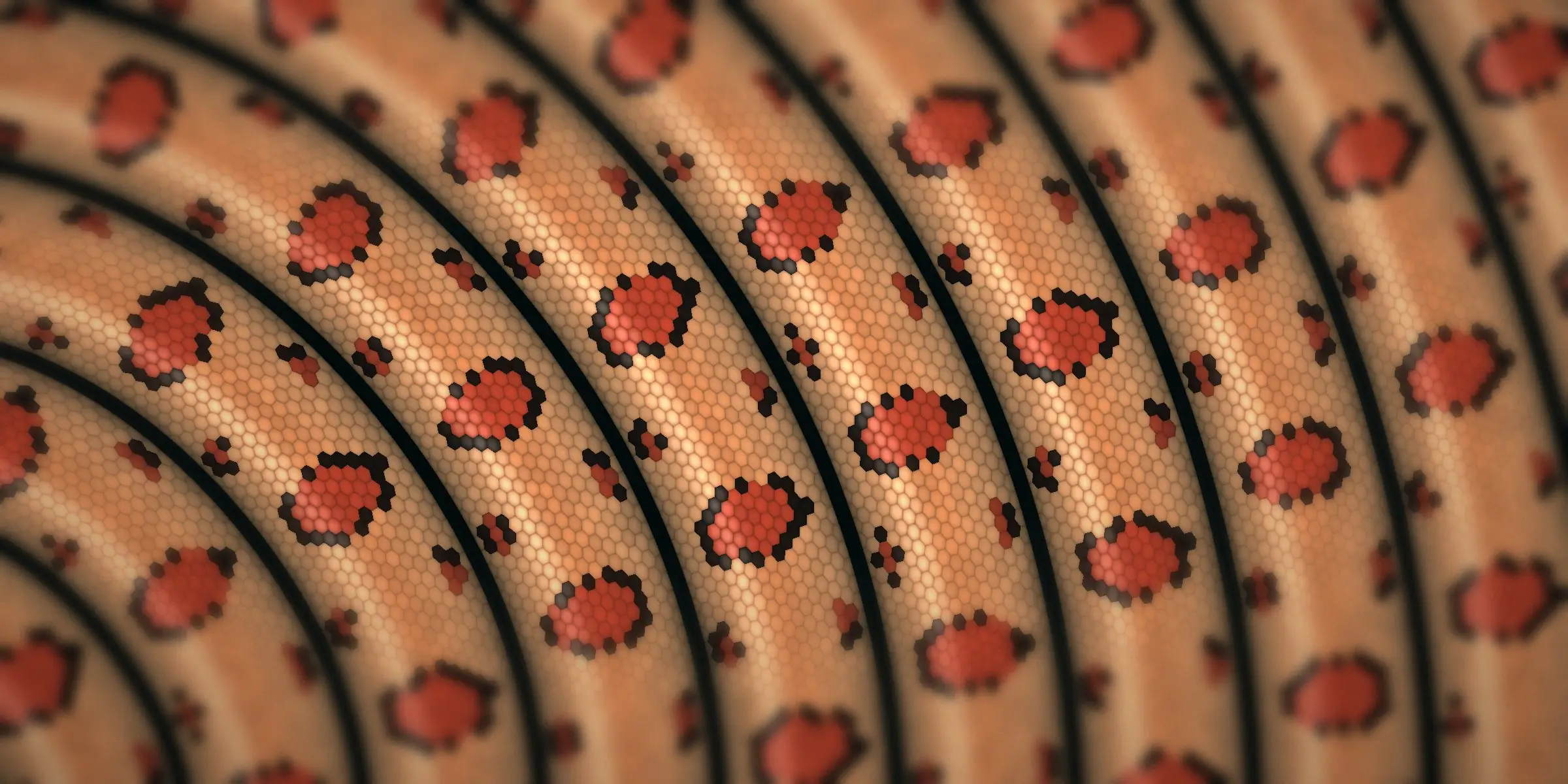
Corn snake
Pantherophis guttatus · Elaphe guttata
The corn snake from the southeastern United States is probably the most commonly kept snake: adaptable, curious and bred in countless color morphs. It likes to climb and needs a cool brumation and an escape-proof enclosure.
Contents 11 sections
Quick tips
- Make it escape-proof: Corn snakes squeeze through surprisingly small gaps. Check vents and doors regularly.
- Plan for brumation: It keeps the snakes fit, even if you don't want to breed. Note the weight before and compare it afterward.
- Give them room to climb: Branches, cork tubes and shelves are what make the enclosure usable for the snake.
- Thaw feeders in warm water, not in the microwave, until they are warm all the way through.
- Quarantine new animals for a few weeks and have a fecal sample tested.
Profile
- Length
- usually 100–150 cm, rarely up to 180 cm
- Weight
- adults about 400–900 g
- Life span
- 15–20 years, some much longer
- Activity
- active at dusk, likes to climb and burrow
Climate and light
- Day
- 24–28 °C (75–82 °F)
- Night
- 18–22 °C (64–72 °F)
- Basking spot
- 30–32 °C (86–90 °F)
- Humidity
- 50–70%
- Light
- 12–14 hours of light during the active season, heat from above with a heat lamp behind a guard. A UVB lamp with shaded areas is recommended.
A humid hide makes shedding easier. Austria requires 60–90% humidity and allows up to 35 °C (95 °F) in one spot.
Enclosure
For an adult of about 120 cm, at least 150 × 60 × 120 cm (L × W × H). This meets the minimums in Germany, Austria and Switzerland. Corn snakes use the height, so add branches and shelves. Young snakes may live in a smaller enclosure at first.
- Substrate
- Soil, humus or bark mulch, with one part slightly damp for burrowing.
- Setup
- Several hides made of wood, cork or stone, forked branches for climbing, a water bowl, a thermometer and a hygrometer. Secure the lid and sliding doors. Corn snakes find every gap.
Source [3]
Minimum sizes
GermanyGuideline
Length 1 × total length, width 0.5 ×, height 1 ×, for up to two animals of about the same size. About 20% more volume for each additional animal.
Source [2]
AustriaLaw
1–2 animals up to 20 cm: 0.1 m² floor area, 0.2 m high · 20–50 cm: 0.2 m², 0.3 m · 50–100 cm: 0.5 m², 0.4 m · adults: 0.9 m², 0.6 m. Add 0.2 m² for each additional adult.
Source [1]
SwitzerlandLaw
The Animal Protection Ordinance does not list corn snakes by name. Enclosures are assessed with the values for rear-fanged snakes: floor area 1 × 0.5 body lengths, height 0.7 body lengths for up to two animals.
Feeding
Hatchlingup to 6 monthsevery 5–7 days
Pinky mouse · one mouse, no thicker than the thickest part of the body
Juvenile6 months to 2 yearsevery 7–10 days
Fuzzy mouse, Hopper mouse · no thicker than the thickest part of the body
Adultfrom about 2 yearsevery 10–14 days
Adult mouse · no thicker than the thickest part of the body
Feed freshly killed or thawed prey. Stop feeding 2–3 weeks before brumation so the gut is empty.
Source [1]
Shedding
Juveniles about once a month, adults every 6–10 weeks. The eyes turn cloudy beforehand. The skin should come off in one piece.
Brumation
Recommended even if you don't plan to breed: about 2–3 months at 10–15 °C (50–59 °F) without food, always with water available. Lower temperature and light over two weeks, and later raise them again over two weeks. Austria gives 2–5 months at 8–15 °C (46–59 °F). Weigh the snake beforehand and only brumate healthy animals.
Breeding
- Sexual maturity
- from about 2 years, females should weigh at least 300 g
- Clutch
- 10–30 eggs, often 12–20
- Incubation
- 55–65 days at 27–28 °C (81–82 °F)
Brumation puts males and females in the mood to mate. Give gravid females a humid laying box, or they risk egg binding.
Protection status and registration
As of October 20, 2026
EU
Not protected under wildlife trade law (neither CITES nor the EU Wildlife Trade Regulation).
Source [5]
Germany
No duty to register and no proof of origin required under species protection law.
Source [6]
Austria
Report to the authorities within two weeks that you keep reptiles. Since July 1, 2026, you need to take a training course (at least 4 × 60 minutes) before your first reptile. A thermometer and a hygrometer are required.
Switzerland
No permit needed.
Source [4]
This is not legal advice. Rules change, so check with the responsible authority if in doubt.
Health
No substitute for a vet. If your animal seems sick, refuses food for an unusually long time or loses weight, see a vet with experience in reptiles.
Cryptosporidiosis
Signs food comes back up days after eating, swelling in the middle of the body, weight loss
What to do See a vet (fecal test) and keep the affected snake strictly separate. It is contagious and rarely curable.
Respiratory infection
Signs wheezing or bubbling when breathing, mucus in the mouth, open-mouth breathing
What to do Check the temperature and see a vet soon.
Mites
Signs tiny black dots, often around the eyes and chin, the snake soaks for unusually long
What to do See a vet. Clean the enclosure thoroughly and replace the decor.
Egg binding
Signs the female seems restless, searches for a long time and doesn't lay, eggs stay visible in the belly for days
What to do Offer a humid laying box. If she still doesn't lay, see a vet.
Stuck shed
Signs skin comes off in pieces, remnants on the eyes or tail tip
What to do Offer a humid hide and raise the humidity.
Sources
- 2. Tierhaltungsverordnung, § 5, § 8 und Anlage 3 (Mindestanforderungen an die Haltung von Reptilien)official
- Gutachten über Mindestanforderungen an die Haltung von Reptilienofficial
- Reptilien – passende Gehege und die richtige Einrichtung
- Tierschutzverordnung (TSchV, SR 455.1), Art. 89 und Anhang 2 (Vorbemerkungen, Tabelle 5 Reptilien)official
- Verordnung (EU) 2026/1383 zur Änderung der Anhänge der Verordnung (EG) Nr. 338/97 (CITES-Vertragsstaatenkonferenz 2025)official
- Bundesartenschutzverordnung (BArtSchV), § 7, §§ 12–13 und Anlagen 5 und 6official
- Tierschutzgesetz (TSchG), § 13 und § 25official
Values without a source are common experience from keeping and breeding. Every animal is different, so watch yours and adjust its care. As of October 20, 2026.
More species.
All species
Ball python
Python regiusThe ball python from West and Central Africa is the most commonly kept python or boa: small, calm and bred in many color morphs.Day26–32 °C79–90 °FHumidity60–80%
Common kingsnake
Lampropeltis getulaCommon kingsnakes come from North America, belong to the genus Lampropeltis and are considered hardy snakes for beginners.Day24–28 °C75–82 °FHumidity50–80%
Carpet python
Morelia spilotaCarpet pythons come in many forms, from the jungle carpet at 1.5–2 meters to the coastal carpet python at up to 3 meters.Day25–30 °C77–86 °FHumidity40–60%
Green tree python
Morelia viridisThe green tree python lives in the rainforests of New Guinea and north-eastern Australia and spends almost its whole life on branches.Day27–32 °C81–90 °FHumidity50–80%