
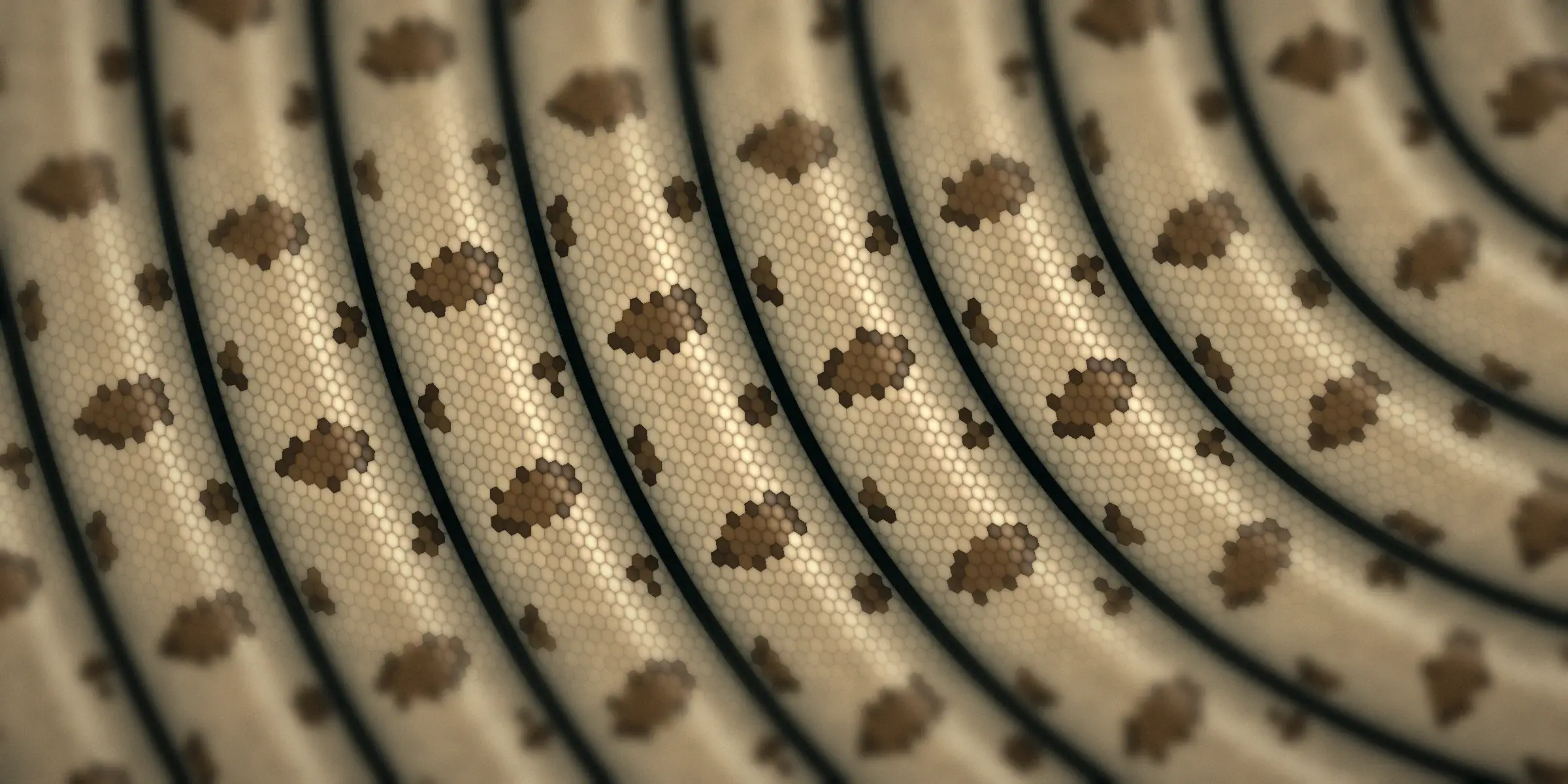
Western hognose
Heterodon nasicus · Western hognose snake, Plains hognose
The western hognose comes from open, dry country in North America, digs a lot and stays small at 50–90 cm. In the wild it mainly eats toads, in the enclosure mice, and it goes through a cool brumation. Its rear teeth release a mildly venomous secretion: bites are rare, but they often swell.
Contents 11 sections
Quick tips
- Take bites seriously, but don't fear them: The enlarged rear teeth release a secretion, and the bite often swells. Remove the snake right away so it can't keep chewing. See a doctor if the swelling is severe.
- Don't smell of mice: Wash your hands before handling the snake, and feed with tongs.
- The threat display is a bluff: Young hognoses hiss, flatten their neck like a cobra or play dead. This usually fades with time.
- Feeding breaks are normal, in males in spring and in all of them in autumn. The scale shows whether there is a problem.
- Before you buy, ask your public order or nature conservation office whether keeping one is allowed in your state.
Profile
- Length
- males usually 50–60 cm, females 70–80 cm, at most about 90 cm
- Weight
- adults about 80–350 g; females grow larger than males
- Life span
- 15–20 years
- Activity
- active by day, digs a lot, hardly climbs
Climate and light
- Day
- 23–28 °C (73–82 °F)
- Night
- 18–20 °C (64–68 °F)
- Basking spot
- 30–35 °C (86–95 °F)
- Humidity
- 50–70%
- Light
- 12–14 hours of light in the active season. UVB with low to medium output is recommended, but other vets don't consider it essential. Austria requires 12–14 hours.
The animal hospital of the Royal Veterinary College recommends only 40–50% humidity for the western hognose and puts the water bowl at the cool end. More important than the number are dry substrate, a humid hide with sphagnum moss and good ventilation after misting: condensation quickly leads to respiratory infections. Juveniles about 28 °C (82 °F) by day and 20–24 °C (68–75 °F) at night. Austria allows up to 35 °C (95 °F) in one spot and requires a small part of the floor to stay slightly damp at all times.
Enclosure
For an adult female of about 80 cm, at least 100 × 50 × 50 cm (L × W × H). This meets the rules in Germany and Austria and matches the recommendation of the Dutch pet information center LICG. Hognoses dig and hardly climb, so floor space matters more than height. Raise juveniles singly in small tanks.
- Substrate
- Dry substrate for digging, such as beech or aspen shavings, bark or shredded paper, at least 5 cm and better 10–15 cm deep. No cedar. The German report names at least 10 cm of sandy substrate, but sand is disputed: the snake can swallow too much of it while eating. So don't feed directly on the substrate.
- Setup
- Hides on the warm and the cool side, a dish with damp sphagnum moss and a heavy water bowl the snake fits into completely. Put rocks and roots directly on the enclosure floor, not on the substrate, or the snake will dig underneath them. Shield heat sources, secure lids and doors well.
Minimum sizes
GermanyGuideline
Length 1 × total length, width 0.5 ×, height 0.5 × for up to two animals of similar size, about 20% more volume for each additional animal. A dry enclosure with a small bathing basin. A guideline that may be undercut by about 10% in individual cases.
Source [7]
AustriaLaw
1–2 animals up to 20 cm: 0.1 m² floor area, 0.2 m high · 20–50 cm: 0.2 m², 0.3 m · adults: 0.5 m², 0.4 m. Add 0.1 m² (adults 0.2 m²) for each additional animal.
Source [6]
SwitzerlandLaw
The Animal Protection Ordinance doesn't name hognose snakes specifically. The enclosure must offer enough space for all the structures the animals need. Expert reports serve as a guideline.
Source [8]
Feeding
Juvenileup to 12 monthsevery 3–5 days
Pinky mouse, Fuzzy mouse · about the size of the head, at first one or two pinkies
Adultfrom about 1 yearevery 7–10 days
Hopper mouse, Adult mouse, Rat pup · about the size of the head, for example a smaller mouse
- Prey size
- no bigger than the width of the head
Prey about the size of the head. A US veterinary clinic allows up to 1.25 times the width of the thickest part of the body.
Feed only dead or thawed mice. Hatchlings live on their yolk at first and only eat about two weeks after hatching. Many don't take a pinky right away; juice from canned tuna or salmon on the mouse helps. Move on to larger feeders once a juvenile manages three pinkies at once. No source gives fixed age limits; in captivity hognoses often become sexually mature at 12–14 months. For adults, the LICG recommends feeding once or twice a week because of their fast metabolism, veterinarians every 7–10 days. Males often eat irregularly, especially from February to May. As long as they hardly lose weight, that's no cause for concern, so weigh them regularly. Bites happen almost only at feeding time, because the snake can't tell the hand from the food: feed with tongs. Don't handle for 2–3 days after feeding.
Shedding
After every shed, check that everything came off, especially over the eyes and on the snout: remnants can cause inflammation. During the shed you can mist daily, and many snakes like to lie fully in the water then. A humid hide with sphagnum moss helps.
Brumation
Recommended when the snake hardly eats in autumn, usually between October and December. Stop feeding at least two weeks before, lower the temperature over a few weeks and let it brumate for 6–12 weeks at 6–13 °C (43–55 °F), dark and quiet, with water and at least 5 cm of substrate. Above 14 °C (57 °F) the snake becomes active again. In the first year of life brumation isn't essential. Afterwards, raise light and warmth slowly and only then start feeding again. Austria gives 3–5 months at 5–12 °C (41–54 °F), depending on origin.
Breeding
- Sexual maturity
- in captivity often at 12–14 months; pair females only from about 50–60 cm, at around 2 years
- Clutch
- usually 8–12 eggs, 2–23 depending on the female's size; well-fed females lay up to twice a year
- Incubation
- 45–60 days at 28 °C (82 °F)
Mating follows brumation; keep males and females apart for a few weeks before. Give the female a dish of damp sand under moss to lay her eggs. Keep the female alone before laying, because hognoses also eat snake eggs. At about 23 °C (73 °F), incubation took 81 days on average. A female loses about a third of her weight when laying.
Protection status and registration
As of October 31, 2026
EU
Not a protected species (neither CITES nor the EU Wildlife Trade Regulation).
Source [12]
Germany
No registration or proof of origin required under species protection law. Dangerous animals, however, are regulated by the federal states, and some ban venomous snakes in general. An overview of the state rules (as of October 2023) doesn't name the western hognose, while a medical article from 2021 names Schleswig-Holstein and Bavaria as states that ban keeping it. Ask your local public order or nature conservation office before you buy.
Austria
Report keeping reptiles to the authority within two weeks. Since July 1, 2026, you need a training course (at least 4 × 60 minutes) before your first reptile. A thermometer and a hygrometer are required.
Switzerland
No permit needed: the Federal Food Safety and Veterinary Office's ordinance on wild animals counts hognose snakes as harmless venomous snakes.
This is not legal advice. Rules change, so check with the responsible authority if in doubt.
Health
No substitute for a vet. If your animal seems sick, refuses food for an unusually long time or loses weight, see a vet with experience in reptiles.
Respiratory infection
Signs open-mouth breathing, wheezing, bubbles at the nostrils; often when kept too damp
What to do Ventilate, lower the humidity and see a vet.
Stuck shed
Signs skin remnants over the eyes or on the snout
What to do Offer a humid hide, have remnants removed by a vet.
Parasites
Signs mites on the skin, weight loss, abnormal feces; common in newly bought animals
What to do Keep new animals apart for a few months, have a fecal sample tested.
Mouth rot
Signs swelling or sores in the mouth, too much mucus
What to do See a vet.
Obesity
Signs an adult keeps getting heavier, often from meals that are too large or too frequent
What to do Feed less often, check prey size, weigh regularly.
Sources
- Huisdierenbijsluiter Westelijke haakneusslang
- Female Reproduction in Western Hognose Snakes (Heterodon nasicus) in the Nebraska Sandhills, USA
- Heterodon nasicus (Plains hog-nosed snake)
- YVCipedia Reptile – Hognose Snake Care Sheet
- Hognose Snake Care
- 2. Tierhaltungsverordnung, § 5, § 8 und Anlage 3 (Mindestanforderungen an die Haltung von Reptilien)official
- Gutachten über Mindestanforderungen an die Haltung von Reptilienofficial
- Tierschutzverordnung (TSchV, SR 455.1), Art. 89 und Anhang 2 (Vorbemerkungen, Tabelle 5 Reptilien)official
- Nutrition in Snakes
- Schlangenbiss der Hakennasennatter (Heterodon nasicus)
- 34 reports of snakebite envenoming by the Western Hognose snake (Heterodon nasicus): a retrospective online survey
- Verordnung (EU) 2026/1383 zur Änderung der Anhänge der Verordnung (EG) Nr. 338/97 (CITES-Vertragsstaatenkonferenz 2025)official
- Bundesartenschutzverordnung (BArtSchV), § 7, §§ 12–13 und Anlagen 5 und 6official
- Überblick über die rechtlichen Regelungen zur Gift- und Gefahrtierhaltung in den Ländern der Bundesrepublik
- Tierschutzgesetz (TSchG), § 13 und § 25official
- Verordnung des BLV über die Haltung von Wildtieren (Wildtierverordnung BLV, SR 455.110.3), Art. 17 und Anhangofficial
Values without a source are common experience from keeping and breeding. Every animal is different, so watch yours and adjust its care. As of October 31, 2026.
More species.
All species
Ball python
Python regiusThe ball python from West and Central Africa is the most commonly kept python or boa: small, calm and bred in many color morphs.Day26–32 °C79–90 °FHumidity60–80%
Corn snake
Pantherophis guttatusThe corn snake from the southeastern United States is probably the most commonly kept snake: adaptable, curious and bred in countless color morphs.Day24–28 °C75–82 °FHumidity50–70%
Common kingsnake
Lampropeltis getulaCommon kingsnakes come from North America, belong to the genus Lampropeltis and are considered hardy snakes for beginners.Day24–28 °C75–82 °FHumidity50–80%
Carpet python
Morelia spilotaCarpet pythons come in many forms, from the jungle carpet at 1.5–2 meters to the coastal carpet python at up to 3 meters.Day25–30 °C77–86 °FHumidity40–60%